

Why Road Connectivity Drives Property Value: The Complete Guide
The Road Beneath Every Price Tag
When buyers evaluate a property, they focus on square footage, interior finishes, and neighborhood aesthetics. But experienced investors and urban economists know that one of the most powerful determinants of real estate value lies not inside the property, it lies beneath it, and beside it: the road. Road connectivity, the quality, density, and accessibility of a location's road network, is a foundational driver of property appreciation. This guide explores why that connection exists, how it affects different property types, and what buyers and developers should look for when assessing road access.
What Is Road Connectivity?
Road connectivity refers to how well a location is integrated into the surrounding road and transport network. It encompasses proximity to arterial roads and highways, the number of intersections and available alternative routes, travel time to key destinations such as employment centers, schools, hospitals, and commercial hubs, and the quality and maintenance of roads within and around the area. A highly connected location offers multiple route options, short travel durations, and reduced dependence on a single access point, all of which translate into tangible economic advantages.
The Economic Logic: Why Connectivity Increases Value
Accessibility Drives Demand
Properties in accessible locations attract a broader pool of buyers and tenants. When commuting is easy, businesses can attract more customers, and employees can reach workplaces without friction. This expanded demand pool creates upward pressure on prices.
Commercial Viability:
Retail, hospitality, and service businesses depend on foot and vehicle traffic. Properties near high-connectivity corridors command premium rents due to the volume and ease of customer access. These commercial premiums often spill over into adjacent residential markets.
Infrastructure Investment Signals
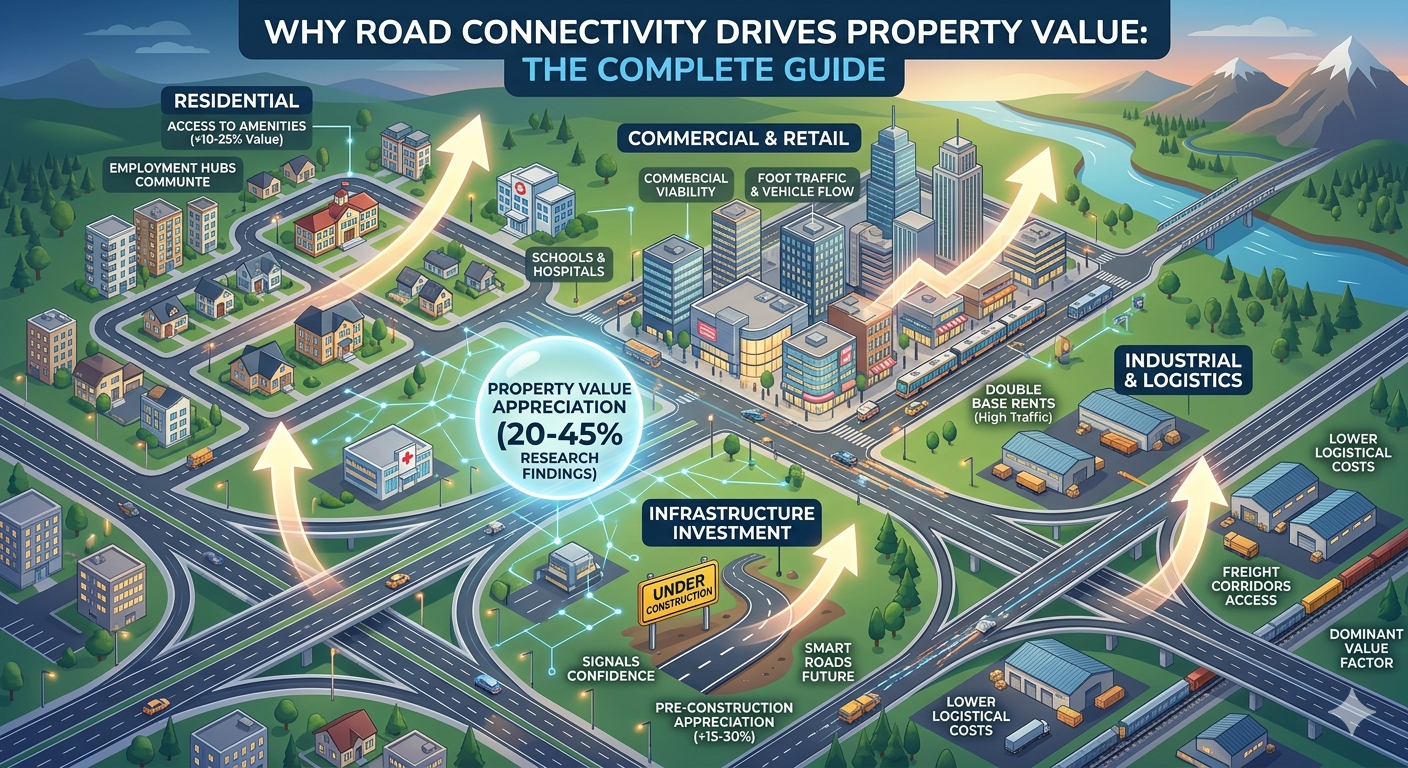
Government and private investment in roads signals long-term confidence in an area. When a ring road, expressway, or new interchange is announced, surrounding property values often rise in anticipation, sometimes by 15–30% before construction even begins.
Lower Logistical Costs
For industrial and warehousing properties, road connectivity directly reduces operational costs. Proximity to arterial roads and freight corridors slashes delivery times and logistics expenses, making such properties more productive and more valuable.
Key Research Findings
Multiple urban economics studies confirm the road-value relationship. Research in emerging markets like India shows that properties within 500 meters of a new arterial road see value appreciation between 20–45% within five years of road completion. In developed markets, the premium for excellent road access is often embedded in baseline pricing, making poor connectivity the primary discount factor rather than a bonus. A notable study by the Lincoln Institute of Land Policy found that transit-oriented and road-accessible developments consistently outperform isolated counterparts over 10-year cycles, especially during economic downturns when accessible properties retain value better.
Road Connectivity by Property Type
Residential: Proximity to schools, hospitals, and employment hubs via well-maintained roads adds 10–25% to resale value. Commercial Retail: Visibility and vehicle access from arterial roads are primary leasing considerations. High-traffic road frontage can double base rents. Industrial/Logistics: Highway proximity and multi-modal connectivity (road + rail) are the dominant value factors, often exceeding all other location criteria. Mixed-Use: Road connectivity activates placemaking potential, enabling foot traffic, outdoor commerce, and community interaction that drives premium positioning.
What Buyers and Investors Should Evaluate
Before committing to a property, a thorough connectivity audit is essential. Consider travel time to the nearest arterial road during peak hours, number of alternative route options to avoid single-point dependency, planned infrastructure projects in the 5–10 year pipeline, road quality and maintenance standards in the area, and last-mile connectivity, including pedestrian and cycling links.
The Future Factor: Smart Roads and Value
As cities evolve, road connectivity is expanding its definition. Smart road infrastructure, including intelligent traffic management, electric vehicle charging corridors, and dedicated logistics lanes, is beginning to command its own price premium. Investors who anticipate these developments are positioning themselves ahead of the next wave of location-based value appreciation.
Conclusion:
Road connectivity is not a secondary amenity, it is a primary value driver. Whether you are buying a home, leasing commercial space, or developing land, the quality of road access determines the ceiling on your investment's potential. In a world where time is the ultimate currency, properties that save time by being well-connected will always command a premium.
When buyers evaluate a property, they focus on square footage, interior finishes, and neighborhood aesthetics. But experienced investors and urban economists know that one of the most powerful determinants of real estate value lies not inside the property, it lies beneath it, and beside it: the road. Road connectivity, the quality, density, and accessibility of a location's road network, is a foundational driver of property appreciation. This guide explores why that connection exists, how it affects different property types, and what buyers and developers should look for when assessing road access.
What Is Road Connectivity?
Road connectivity refers to how well a location is integrated into the surrounding road and transport network. It encompasses proximity to arterial roads and highways, the number of intersections and available alternative routes, travel time to key destinations such as employment centers, schools, hospitals, and commercial hubs, and the quality and maintenance of roads within and around the area. A highly connected location offers multiple route options, short travel durations, and reduced dependence on a single access point, all of which translate into tangible economic advantages.
The Economic Logic: Why Connectivity Increases Value
Accessibility Drives Demand
Properties in accessible locations attract a broader pool of buyers and tenants. When commuting is easy, businesses can attract more customers, and employees can reach workplaces without friction. This expanded demand pool creates upward pressure on prices.
Commercial Viability:
Retail, hospitality, and service businesses depend on foot and vehicle traffic. Properties near high-connectivity corridors command premium rents due to the volume and ease of customer access. These commercial premiums often spill over into adjacent residential markets.
Infrastructure Investment Signals
Government and private investment in roads signals long-term confidence in an area. When a ring road, expressway, or new interchange is announced, surrounding property values often rise in anticipation, sometimes by 15–30% before construction even begins.
Lower Logistical Costs
For industrial and warehousing properties, road connectivity directly reduces operational costs. Proximity to arterial roads and freight corridors slashes delivery times and logistics expenses, making such properties more productive and more valuable.
Key Research Findings
Multiple urban economics studies confirm the road-value relationship. Research in emerging markets like India shows that properties within 500 meters of a new arterial road see value appreciation between 20–45% within five years of road completion. In developed markets, the premium for excellent road access is often embedded in baseline pricing, making poor connectivity the primary discount factor rather than a bonus. A notable study by the Lincoln Institute of Land Policy found that transit-oriented and road-accessible developments consistently outperform isolated counterparts over 10-year cycles, especially during economic downturns when accessible properties retain value better.
Road Connectivity by Property Type
Residential: Proximity to schools, hospitals, and employment hubs via well-maintained roads adds 10–25% to resale value. Commercial Retail: Visibility and vehicle access from arterial roads are primary leasing considerations. High-traffic road frontage can double base rents. Industrial/Logistics: Highway proximity and multi-modal connectivity (road + rail) are the dominant value factors, often exceeding all other location criteria. Mixed-Use: Road connectivity activates placemaking potential, enabling foot traffic, outdoor commerce, and community interaction that drives premium positioning.
What Buyers and Investors Should Evaluate
Before committing to a property, a thorough connectivity audit is essential. Consider travel time to the nearest arterial road during peak hours, number of alternative route options to avoid single-point dependency, planned infrastructure projects in the 5–10 year pipeline, road quality and maintenance standards in the area, and last-mile connectivity, including pedestrian and cycling links.
The Future Factor: Smart Roads and Value
As cities evolve, road connectivity is expanding its definition. Smart road infrastructure, including intelligent traffic management, electric vehicle charging corridors, and dedicated logistics lanes, is beginning to command its own price premium. Investors who anticipate these developments are positioning themselves ahead of the next wave of location-based value appreciation.
Conclusion:
Road connectivity is not a secondary amenity, it is a primary value driver. Whether you are buying a home, leasing commercial space, or developing land, the quality of road access determines the ceiling on your investment's potential. In a world where time is the ultimate currency, properties that save time by being well-connected will always command a premium.