"Land vs. Gold in 2026: A Strategic Shift Towards Building Wealth through Real Estate"
Explore how the landscape of wealth generation is evolving! As we move into 2026, the age-old debate of land versus gold takes on new meaning. Discover the compelling case for investing in real estate and how it can be your pathway to financial prosperity. Dive into the strategic transition that’s reshaping the way we think about wealth creation!
The Great Portfolio Shift of 2026
For generations, Indian investors have relied on two enduring pillars for wealth creation: land and gold. Both assets hold deep cultural significance, symbolising security, heritage, and prosperity. While gold has often served as a protective measure during financial uncertainty, the investment landscape in 2026 is evolving, prompting a crucial reassessment of these traditional assets.
The pivotal question for today’s investors transcends the binary choice of "Which asset is safer?" It's more nuanced and dynamic: "Which asset offers the potential for greater future value and growth?" The response relies on various elements, including the timing of the decision, the underlying purpose behind it, the potential for future appreciation in value, and the level of demand in the market.
Currently, raw land is entering a distinctive phase characterised by remarkable opportunities—driven by unprecedented infrastructure development and urban expansion. As more people and industries flock to burgeoning urban centres, strategically located land parcels in high-growth corridors present investors with opportunities not seen in a decade for substantial returns on investment (ROI).
This guide will explore the compelling reasons why astute investors are transitioning from passive investments like gold to proactive strategies involving land acquisition, and why now—2026—is the pivotal moment to seize these opportunities.
1. Gold: The Traditional Safe Haven and Its Limitations
Gold has long been viewed as a cornerstone of financial security. Revered as an investment vehicle and a tangible asset, it has gained its reputation as a safe haven for investors facing economic uncertainty. Yet, understanding the limitations of gold is essential for those aiming for substantial wealth accumulation in today’s economic climate.
Reasons Investors Traditionally Favor Gold:
- Hedge Against Inflation: Gold has historically preserved purchasing power over extended periods, providing a buffer against inflationary pressures.
- High Liquidity: One of the standout features of gold is its liquidity; it can be readily converted to cash globally, allowing investors to access funds quickly when needed.
- Ease of Storage: Gold is compact, portable, and can be securely stored in various forms, making it a convenient asset for investors.
- Crisis Management: In times of global uncertainty, conflict, or currency devaluation, gold often experiences a surge in demand, maintaining or even increasing its value.
The 2026 Reality Check: Moving from Preservation to Multiplication
Though gold excels at safeguarding wealth, it is crucial to recognize its inherent limitations. Primarily, gold is a passive asset, meaning it does not generate income, yield, or cash flow. Unlike land, which can be developed, leased, or improved upon, gold’s value appreciation is largely influenced by macroeconomic conditions, including cycles of fear related to inflation and fluctuating interest rates. In a strong economic climate, returns on gold investments may hover between 8% to 12%.
For investors looking to achieve exponential wealth growth, a shift towards active assets is necessary. Raw land offers numerous avenues for value creation—such as development potential, rental income, and appreciation through local market improvements. As we advance through 2026, the proactive acquisition of strategically located land presents a more compelling route to building substantial wealth compared to merely holding gold as a passive hedge.
2. Land: The Unmatched Asset for Wealth Multiplication
Land represents more than merely a secure investment; it is a dynamic asset that appreciates in value over time due to its intrinsic scarcity. As the renowned author Mark Twain wisely remarked, "Buy land, they're not making it anymore." Unlike gold or other tangible assets, land provides unique advantages for compounding wealth through various mechanisms:
- Absolute Fixed Supply: One of the defining characteristics of land is its fixed supply. No new land can be created, which makes it a finite resource. As the global population continues to grow and urbanization expands, the demand for land in populated areas increases. This demand, combined with the limited availability, naturally drives prices upward. Consequently, investing in land can yield substantial returns as urban areas develop and expand.
- Utility and Development Potential: Land offers incredible versatility, serving as a blank canvas for various development opportunities. Investors can transform parcels of land into residential neighborhoods, commercial centers, industrial warehouses, or even recreational spaces. Additionally, land can be leased for agricultural purposes, providing a diverse array of income streams and potential for growth. The potential to change the use of land makes it an attractive asset for those looking to diversify their investment portfolios.
- Leverage Opportunities: Financial institutions often recognize the value of land and are more inclined to offer favorable financing terms for it. Investors can leverage their land holdings as collateral to secure loans, which can then be used to fund business ventures or acquire additional real estate. This leverage enables investors to amplify their purchasing power and capitalize on various investment opportunities, further increasing their potential return on investment.
- Income Possibilities: In addition to capital appreciation, land can generate a consistent stream of passive income. Investors can lease land for short-term uses, such as seasonal crops or event venues, or enter into longer-term agreements for agricultural rentals. This dual benefit—earning income while holding an appreciating asset—makes land an appealing choice for investors seeking financial stability.
Why Land Offers Greater Potential for Profit
As urban environments expand, land located within designated growth corridors experiences a dramatic appreciation in value. When essential infrastructure, such as roads, schools, and services, is established in an area, the demand for housing and commercial projects surges. This increase in demand, coupled with the limited supply of land, leads to significant price escalations.
3. Why 2026 is a Critical Time to Buy Land
In the realm of real estate, timing plays a crucial role in determining the success of investments. Historically, some of the most profitable returns arise from purchasing land in areas before they gain mainstream appeal. As we look ahead to 2026, several macroeconomic factors suggest that this year presents a particularly opportune moment to invest in land. Here’s a more detailed exploration of these factors:
A) Infrastructure-Led Growth
We are currently witnessing an unprecedented era of infrastructure development, marked by significant government and private sector investments. Whenever new transportation projects—such as highways, ring roads, industrial zones, metro corridors, or large-scale township developments—are announced, they tend to have an immediate impact on the value of surrounding land. These projects not only enhance connectivity but also attract businesses and residents to the area.
Opportunity: Savvy investors who acquire properties in these burgeoning corridors before construction begins will be best positioned to reap substantial financial rewards as property values rise significantly once the infrastructure is completed.
B) Aggressive Urban Expansion
Urban areas are expanding their boundaries at an accelerated pace, driven by population growth and economic development. Regions that were once regarded as "too far" from city centers are now evolving into highly desirable suburban zones, complete with amenities and services. This trend presents a unique opportunity for investors because land on the peripheries is increasingly viewed as a viable long-term investment.
In many cases, properties in these areas offer larger spaces at more affordable prices compared to urban centers, making them attractive options for both homeowners and investors seeking rental income.
C) Rapidly Depleting Prime Inventory
While commodities like gold can always be purchased at fluctuating market rates, prime land—especially in sought-after locations—cannot be reproduced. As the most desirable plots near key growth corridors disappear at an alarming rate, they become scarce. This scarcity creates a compelling sense of urgency for potential buyers.
Impact: Early investors are granted significant pricing power, as demand continues to outstrip supply, resulting in valuable appreciation over time. The realization of this scarcity can motivate buyers to act quickly, driving up competition and prices.
D) Changes in Lifestyle and Investment Demand
The COVID-19 pandemic has fundamentally shifted how people view land ownership, altering buyer behavior in significant ways. Individuals are no longer acquiring land solely for traditional purposes such as farming or building primary residences. Instead, today’s buyers are motivated by diverse reasons, including:
Creating weekend homes or tranquil getaways that provide an escape from city life,
Investing in managed farmland that offers a lifestyle choice,
Planning for retirement with properties designed for long-term living, and
Diversifying their portfolios and establishing legacy assets for future generations.
As a result, the demand for land has broadened beyond traditional real estate investors to include a wider array of interest groups, driving up prices and enhancing market dynamics. This diversified demand significantly boosts property values and makes land investment increasingly attractive.
In conclusion, the convergence of infrastructure development, urban expansion, dwindling prime inventory, and evolving buyer preferences suggests that 2026 will be a pivotal year for land investment. Those who act strategically now may position themselves for substantial profits as these trends unfold.
4. Head-to-Head: Land vs. Gold
To determine which asset aligns with your financial goals, consider this direct comparison:
Investment Goal
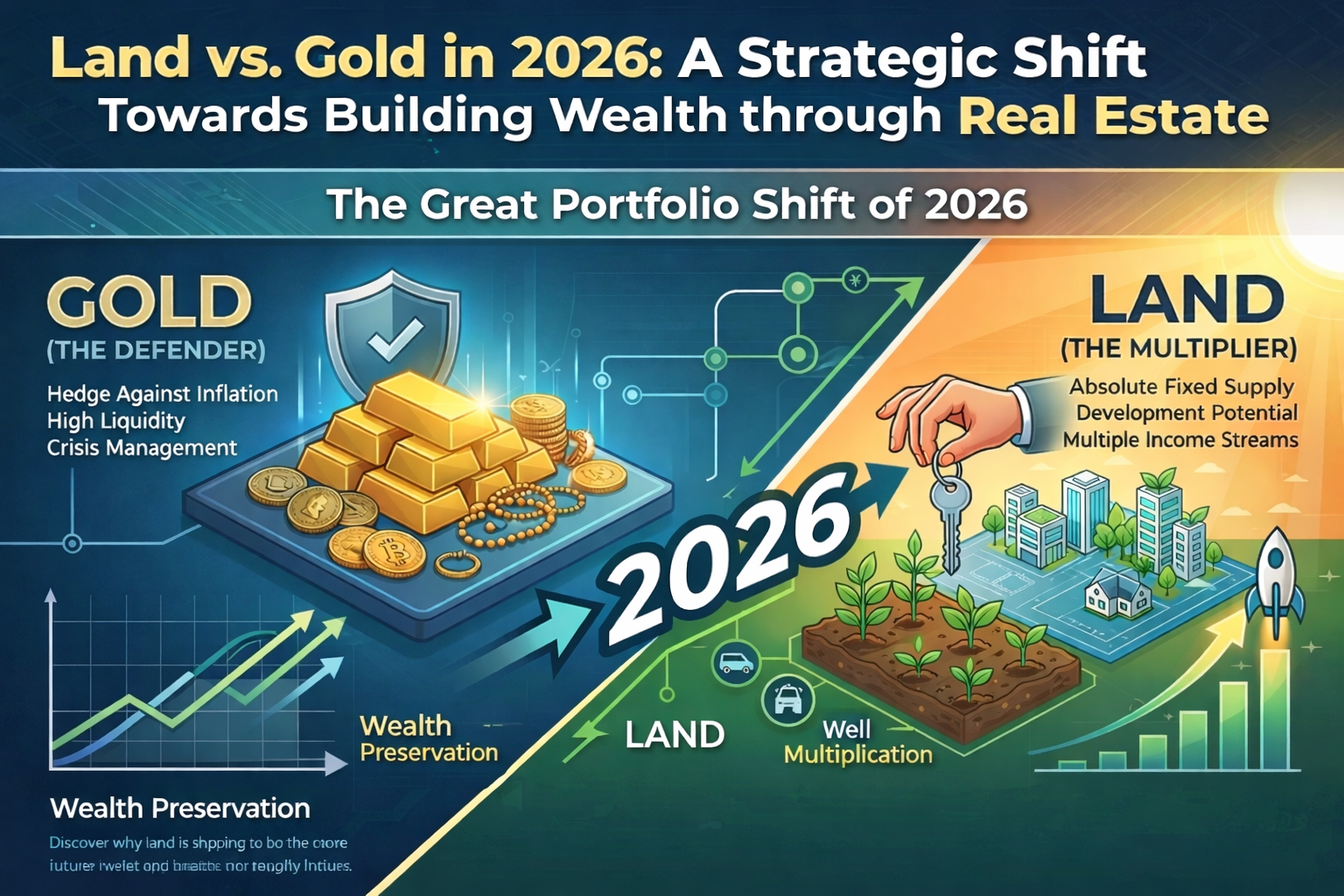
1. Gold (The Defender): The Ultimate Wealth Guardian:
In times of economic turbulence, gold shines as a beacon of strength. Renowned for its ability to preserve wealth and provide emergency liquidity, this timeless asset stands strong against inflation. Its linear growth offers stability, and its portability makes it a reliable choice for investors. In a world filled with global economic uncertainty, gold remains a steadfast ally for those looking to secure their financial future. Embrace the golden shield against instability!
2. Land: The Ultimate Wealth Multiplier:
Imagine harnessing the power of land to create a legacy of wealth that spans generations! With high-growth opportunities for capital appreciation and exponential growth driven by infrastructure developments, investing in land means tapping into a world of possibilities. This arena is thriving with dynamic activities in rental properties, leasing ventures, and commercial development, all contributing to a robust financial future. By focusing on local infrastructure, demographics, and unique development factors, you can maximize your investments and watch your wealth soar. It’s time to build a foundation of prosperity that can be passed down, creating lasting value for you and your family!
The Ultimate Wealth Strategy: A Comprehensive Approach to Investing
Wealthy investors have long understood the critical importance of diversifying their investment portfolios to effectively balance risk and reward. This strategy is not just a trend; it’s a fundamental principle that can help mitigate financial losses and enhance overall returns. One key asset that often finds its place in these well-structured portfolios is gold. Gold is widely recognized as a safe-haven asset, and its value tends to remain stable during times of economic fluctuations. Investors turn to gold primarily for short-term protection and stability, especially during periods of market volatility or inflation. Historically, gold has served as a reliable store of value, preserving wealth even when other assets may falter. By including gold in their portfolios, investors can create a cushion against uncertain economic conditions, safeguarding their assets from the unpredictable nature of markets. In addition to gold, wealthy investors also place tremendous emphasis on land and real estate as a cornerstone of their long-term investment strategies. Real estate is unique in that it has a natural tendency to appreciate over time, providing investors with a valuable asset that increases in worth. Beyond mere appreciation, land and properties can generate significant passive income through rental opportunities. This income stream can provide financial security and stability, allowing investors to reinvest in other ventures or bolster their savings. Moreover, land ownership opens up a plethora of potential for development and resale, which can lead to substantial returns on investment. Whether it’s building new properties, improving existing structures, or simply holding land until the market conditions are favorable for sale, the possibilities are vast. By strategically combining the immediate stability of gold with the long-term advantages of land ownership, investors can craft a robust and resilient portfolio. This not only equips them to weather economic uncertainties but also positions them to capitalise on growth opportunities as they arise. In this way, a thoughtful, diversified investment approach serves as a means of building lasting wealth and maintaining financial well-being in an ever-changing financial landscape.
5. The Fatal Flaw: The Biggest Mistake Land Investors Make
One of the most significant mistakes that prospective land buyers often make is waiting for tangible, visual proof of development before making their investment. This approach can lead to missed opportunities and diminished returns. Many retail investors typically hold off until certain indicators are apparent, such as:
- The completion of four-lane roads that connect the area to nearby urban centers,
- The launch of luxurious villas and commercial centers, signaling a shift in the neighborhood's desirability,
- The location is gaining popularity and becoming a topic of conversation among potential residents and investors,
- The property prices are experiencing a sharp increase, often doubling or more from their original values. By the time these signs of development are visible, the best opportunities for investment may already have passed. At this stage, many investors find themselves not truly investing but instead paying a premium for the foresight that early investors demonstrated. The potential for easy appreciation has likely vanished, leaving less room for significant returns. The ideal time to invest in land is when key infrastructure plans are laid out and documented, even if they have not yet come to fruition, when demand is just starting to materialize, when legal regulations are clear and favorable, and when the market remains undervalued. This is the sweet spot where exponential gains can begin to manifest, offering savvy investors the chance to capitalize on up-and-coming locations before they become highly sought after. By recognising and acting during this critical phase, land buyers can position themselves for greater financial success in the long term.
6. Why This Moment Matters
Gold has long been recognised as a robust and defensive asset, making it a staple in many diversified investment portfolios. Yet, for those who aspire to create substantial wealth, establish a lasting generational legacy, and achieve significantly higher returns on investment (ROI), land offers a unique and unmatched strategic opportunity, particularly in the rapidly evolving peri-urban areas. Investing in the right piece of land—situated in a promising growth corridor and acquired at an opportune moment—has the potential to systematically outperform most traditional asset classes such as stocks and bonds. Historically, some of the greatest fortunes in real estate are accumulated quietly, well before the general public becomes aware of the potential for significant returns. The current landscape of land investment points to 2026 as a pivotal year for seizing these opportunities. As urban areas continue to expand and develop, the demand for land in strategically located regions is expected to rise. This trend provides early investors with a substantial advantage, as the value of these land parcels will likely increase as growth continues. Now is a good time to prepare and plan to invest in land with potential for future appreciation.
Gold has long been recognised as a reliable safeguard for your wealth, providing a sense of security in uncertain economic climates. However, investing in land offers more than just protection; it serves as a transformative asset that can significantly enhance your future opportunities. Acquiring land today doesn't just secure your financial standing; it lays down a strong foundation for generational wealth, allowing your family to thrive for years to come. Take action now to start building a future that could yield benefits for decades ahead.
Historically, the most substantial fortunes in real estate have been amassed during periods when the market is still accessible, before it becomes overcrowded with eager buyers. We currently find ourselves in a unique window of opportunity for strategic land acquisition, which is projected to remain open until 2026. This timeline presents an exceptional chance to invest in valuable properties that are likely to appreciate significantly once demand inevitably rises. Are you ready to position yourself advantageously and capitalise on this pivotal moment to ensure your success in the next wave of real estate growth? The guiding principle is straightforward: do not procrastinate on purchasing land; instead, act decisively and invest in land now to take full advantage of its potential for appreciation. By identifying and investing in high-growth corridors slated for significant development in 2026, you set yourself up to reap the benefits before the rest of the market catches on. Securing properties in these key areas today can lead to remarkable returns on investment in the future, making now the ideal time to act and stay ahead of the curve.
The Great Portfolio Shift of 2026
For generations, Indian investors have relied on two enduring pillars for wealth creation: land and gold. Both assets hold deep cultural significance, symbolising security, heritage, and prosperity. While gold has often served as a protective measure during financial uncertainty, the investment landscape in 2026 is evolving, prompting a crucial reassessment of these traditional assets.
The pivotal question for today’s investors transcends the binary choice of "Which asset is safer?" It's more nuanced and dynamic: "Which asset offers the potential for greater future value and growth?" The response relies on various elements, including the timing of the decision, the underlying purpose behind it, the potential for future appreciation in value, and the level of demand in the market.
Currently, raw land is entering a distinctive phase characterised by remarkable opportunities—driven by unprecedented infrastructure development and urban expansion. As more people and industries flock to burgeoning urban centres, strategically located land parcels in high-growth corridors present investors with opportunities not seen in a decade for substantial returns on investment (ROI).
This guide will explore the compelling reasons why astute investors are transitioning from passive investments like gold to proactive strategies involving land acquisition, and why now—2026—is the pivotal moment to seize these opportunities.
1. Gold: The Traditional Safe Haven and Its Limitations
Gold has long been viewed as a cornerstone of financial security. Revered as an investment vehicle and a tangible asset, it has gained its reputation as a safe haven for investors facing economic uncertainty. Yet, understanding the limitations of gold is essential for those aiming for substantial wealth accumulation in today’s economic climate.
Reasons Investors Traditionally Favor Gold:
- Hedge Against Inflation: Gold has historically preserved purchasing power over extended periods, providing a buffer against inflationary pressures.
- High Liquidity: One of the standout features of gold is its liquidity; it can be readily converted to cash globally, allowing investors to access funds quickly when needed.
- Ease of Storage: Gold is compact, portable, and can be securely stored in various forms, making it a convenient asset for investors.
- Crisis Management: In times of global uncertainty, conflict, or currency devaluation, gold often experiences a surge in demand, maintaining or even increasing its value.
The 2026 Reality Check: Moving from Preservation to Multiplication
Though gold excels at safeguarding wealth, it is crucial to recognize its inherent limitations. Primarily, gold is a passive asset, meaning it does not generate income, yield, or cash flow. Unlike land, which can be developed, leased, or improved upon, gold’s value appreciation is largely influenced by macroeconomic conditions, including cycles of fear related to inflation and fluctuating interest rates. In a strong economic climate, returns on gold investments may hover between 8% to 12%.
For investors looking to achieve exponential wealth growth, a shift towards active assets is necessary. Raw land offers numerous avenues for value creation—such as development potential, rental income, and appreciation through local market improvements. As we advance through 2026, the proactive acquisition of strategically located land presents a more compelling route to building substantial wealth compared to merely holding gold as a passive hedge.
2. Land: The Unmatched Asset for Wealth Multiplication
Land represents more than merely a secure investment; it is a dynamic asset that appreciates in value over time due to its intrinsic scarcity. As the renowned author Mark Twain wisely remarked, "Buy land, they're not making it anymore." Unlike gold or other tangible assets, land provides unique advantages for compounding wealth through various mechanisms:
- Absolute Fixed Supply: One of the defining characteristics of land is its fixed supply. No new land can be created, which makes it a finite resource. As the global population continues to grow and urbanization expands, the demand for land in populated areas increases. This demand, combined with the limited availability, naturally drives prices upward. Consequently, investing in land can yield substantial returns as urban areas develop and expand.
- Utility and Development Potential: Land offers incredible versatility, serving as a blank canvas for various development opportunities. Investors can transform parcels of land into residential neighborhoods, commercial centers, industrial warehouses, or even recreational spaces. Additionally, land can be leased for agricultural purposes, providing a diverse array of income streams and potential for growth. The potential to change the use of land makes it an attractive asset for those looking to diversify their investment portfolios.
- Leverage Opportunities: Financial institutions often recognize the value of land and are more inclined to offer favorable financing terms for it. Investors can leverage their land holdings as collateral to secure loans, which can then be used to fund business ventures or acquire additional real estate. This leverage enables investors to amplify their purchasing power and capitalize on various investment opportunities, further increasing their potential return on investment.
- Income Possibilities: In addition to capital appreciation, land can generate a consistent stream of passive income. Investors can lease land for short-term uses, such as seasonal crops or event venues, or enter into longer-term agreements for agricultural rentals. This dual benefit—earning income while holding an appreciating asset—makes land an appealing choice for investors seeking financial stability.
Why Land Offers Greater Potential for Profit
As urban environments expand, land located within designated growth corridors experiences a dramatic appreciation in value. When essential infrastructure, such as roads, schools, and services, is established in an area, the demand for housing and commercial projects surges. This increase in demand, coupled with the limited supply of land, leads to significant price escalations.
3. Why 2026 is a Critical Time to Buy Land
In the realm of real estate, timing plays a crucial role in determining the success of investments. Historically, some of the most profitable returns arise from purchasing land in areas before they gain mainstream appeal. As we look ahead to 2026, several macroeconomic factors suggest that this year presents a particularly opportune moment to invest in land. Here’s a more detailed exploration of these factors:
A) Infrastructure-Led Growth
We are currently witnessing an unprecedented era of infrastructure development, marked by significant government and private sector investments. Whenever new transportation projects—such as highways, ring roads, industrial zones, metro corridors, or large-scale township developments—are announced, they tend to have an immediate impact on the value of surrounding land. These projects not only enhance connectivity but also attract businesses and residents to the area.
Opportunity: Savvy investors who acquire properties in these burgeoning corridors before construction begins will be best positioned to reap substantial financial rewards as property values rise significantly once the infrastructure is completed.
B) Aggressive Urban Expansion
Urban areas are expanding their boundaries at an accelerated pace, driven by population growth and economic development. Regions that were once regarded as "too far" from city centers are now evolving into highly desirable suburban zones, complete with amenities and services. This trend presents a unique opportunity for investors because land on the peripheries is increasingly viewed as a viable long-term investment.
In many cases, properties in these areas offer larger spaces at more affordable prices compared to urban centers, making them attractive options for both homeowners and investors seeking rental income.
C) Rapidly Depleting Prime Inventory
While commodities like gold can always be purchased at fluctuating market rates, prime land—especially in sought-after locations—cannot be reproduced. As the most desirable plots near key growth corridors disappear at an alarming rate, they become scarce. This scarcity creates a compelling sense of urgency for potential buyers.
Impact: Early investors are granted significant pricing power, as demand continues to outstrip supply, resulting in valuable appreciation over time. The realization of this scarcity can motivate buyers to act quickly, driving up competition and prices.
D) Changes in Lifestyle and Investment Demand
The COVID-19 pandemic has fundamentally shifted how people view land ownership, altering buyer behavior in significant ways. Individuals are no longer acquiring land solely for traditional purposes such as farming or building primary residences. Instead, today’s buyers are motivated by diverse reasons, including:
Creating weekend homes or tranquil getaways that provide an escape from city life,
Investing in managed farmland that offers a lifestyle choice,
Planning for retirement with properties designed for long-term living, and
Diversifying their portfolios and establishing legacy assets for future generations.
As a result, the demand for land has broadened beyond traditional real estate investors to include a wider array of interest groups, driving up prices and enhancing market dynamics. This diversified demand significantly boosts property values and makes land investment increasingly attractive.
In conclusion, the convergence of infrastructure development, urban expansion, dwindling prime inventory, and evolving buyer preferences suggests that 2026 will be a pivotal year for land investment. Those who act strategically now may position themselves for substantial profits as these trends unfold.
4. Head-to-Head: Land vs. Gold
To determine which asset aligns with your financial goals, consider this direct comparison:
Investment Goal
1. Gold (The Defender): The Ultimate Wealth Guardian:
In times of economic turbulence, gold shines as a beacon of strength. Renowned for its ability to preserve wealth and provide emergency liquidity, this timeless asset stands strong against inflation. Its linear growth offers stability, and its portability makes it a reliable choice for investors. In a world filled with global economic uncertainty, gold remains a steadfast ally for those looking to secure their financial future. Embrace the golden shield against instability!
2. Land: The Ultimate Wealth Multiplier:
Imagine harnessing the power of land to create a legacy of wealth that spans generations! With high-growth opportunities for capital appreciation and exponential growth driven by infrastructure developments, investing in land means tapping into a world of possibilities. This arena is thriving with dynamic activities in rental properties, leasing ventures, and commercial development, all contributing to a robust financial future. By focusing on local infrastructure, demographics, and unique development factors, you can maximize your investments and watch your wealth soar. It’s time to build a foundation of prosperity that can be passed down, creating lasting value for you and your family!
The Ultimate Wealth Strategy: A Comprehensive Approach to Investing
Wealthy investors have long understood the critical importance of diversifying their investment portfolios to effectively balance risk and reward. This strategy is not just a trend; it’s a fundamental principle that can help mitigate financial losses and enhance overall returns. One key asset that often finds its place in these well-structured portfolios is gold. Gold is widely recognized as a safe-haven asset, and its value tends to remain stable during times of economic fluctuations. Investors turn to gold primarily for short-term protection and stability, especially during periods of market volatility or inflation. Historically, gold has served as a reliable store of value, preserving wealth even when other assets may falter. By including gold in their portfolios, investors can create a cushion against uncertain economic conditions, safeguarding their assets from the unpredictable nature of markets. In addition to gold, wealthy investors also place tremendous emphasis on land and real estate as a cornerstone of their long-term investment strategies. Real estate is unique in that it has a natural tendency to appreciate over time, providing investors with a valuable asset that increases in worth. Beyond mere appreciation, land and properties can generate significant passive income through rental opportunities. This income stream can provide financial security and stability, allowing investors to reinvest in other ventures or bolster their savings. Moreover, land ownership opens up a plethora of potential for development and resale, which can lead to substantial returns on investment. Whether it’s building new properties, improving existing structures, or simply holding land until the market conditions are favorable for sale, the possibilities are vast. By strategically combining the immediate stability of gold with the long-term advantages of land ownership, investors can craft a robust and resilient portfolio. This not only equips them to weather economic uncertainties but also positions them to capitalise on growth opportunities as they arise. In this way, a thoughtful, diversified investment approach serves as a means of building lasting wealth and maintaining financial well-being in an ever-changing financial landscape.
5. The Fatal Flaw: The Biggest Mistake Land Investors Make
One of the most significant mistakes that prospective land buyers often make is waiting for tangible, visual proof of development before making their investment. This approach can lead to missed opportunities and diminished returns. Many retail investors typically hold off until certain indicators are apparent, such as:
- The completion of four-lane roads that connect the area to nearby urban centers,
- The launch of luxurious villas and commercial centers, signaling a shift in the neighborhood's desirability,
- The location is gaining popularity and becoming a topic of conversation among potential residents and investors,
- The property prices are experiencing a sharp increase, often doubling or more from their original values. By the time these signs of development are visible, the best opportunities for investment may already have passed. At this stage, many investors find themselves not truly investing but instead paying a premium for the foresight that early investors demonstrated. The potential for easy appreciation has likely vanished, leaving less room for significant returns. The ideal time to invest in land is when key infrastructure plans are laid out and documented, even if they have not yet come to fruition, when demand is just starting to materialize, when legal regulations are clear and favorable, and when the market remains undervalued. This is the sweet spot where exponential gains can begin to manifest, offering savvy investors the chance to capitalize on up-and-coming locations before they become highly sought after. By recognising and acting during this critical phase, land buyers can position themselves for greater financial success in the long term.
6. Why This Moment Matters
Gold has long been recognised as a robust and defensive asset, making it a staple in many diversified investment portfolios. Yet, for those who aspire to create substantial wealth, establish a lasting generational legacy, and achieve significantly higher returns on investment (ROI), land offers a unique and unmatched strategic opportunity, particularly in the rapidly evolving peri-urban areas. Investing in the right piece of land—situated in a promising growth corridor and acquired at an opportune moment—has the potential to systematically outperform most traditional asset classes such as stocks and bonds. Historically, some of the greatest fortunes in real estate are accumulated quietly, well before the general public becomes aware of the potential for significant returns. The current landscape of land investment points to 2026 as a pivotal year for seizing these opportunities. As urban areas continue to expand and develop, the demand for land in strategically located regions is expected to rise. This trend provides early investors with a substantial advantage, as the value of these land parcels will likely increase as growth continues. Now is a good time to prepare and plan to invest in land with potential for future appreciation.
Gold has long been recognised as a reliable safeguard for your wealth, providing a sense of security in uncertain economic climates. However, investing in land offers more than just protection; it serves as a transformative asset that can significantly enhance your future opportunities. Acquiring land today doesn't just secure your financial standing; it lays down a strong foundation for generational wealth, allowing your family to thrive for years to come. Take action now to start building a future that could yield benefits for decades ahead.
Historically, the most substantial fortunes in real estate have been amassed during periods when the market is still accessible, before it becomes overcrowded with eager buyers. We currently find ourselves in a unique window of opportunity for strategic land acquisition, which is projected to remain open until 2026. This timeline presents an exceptional chance to invest in valuable properties that are likely to appreciate significantly once demand inevitably rises. Are you ready to position yourself advantageously and capitalise on this pivotal moment to ensure your success in the next wave of real estate growth? The guiding principle is straightforward: do not procrastinate on purchasing land; instead, act decisively and invest in land now to take full advantage of its potential for appreciation. By identifying and investing in high-growth corridors slated for significant development in 2026, you set yourself up to reap the benefits before the rest of the market catches on. Securing properties in these key areas today can lead to remarkable returns on investment in the future, making now the ideal time to act and stay ahead of the curve.